Pages

Showing posts with label Rochor Rd. Show all posts

Jul 26, 2008

When was 7th Storey Hotel Usurped?

I hope you enjoy reading my on-site coverage of 7th Storey Hotel.

Today we will look at another question - when was 7th Storey Hotel usurped?

From the October 27, 2002 Sunday Times:

But 49 years ago when it was first erected, the hotel was the tallest protrusion on the southern skyline. "If you got the roof, it had the best views of the beach," says Miss Shirley Fong, 26, its operations manager.

Regarding this tallest protrusion on the southern skyline, the February 22, 2004 Chinese newspaper Xin Ming Ri Bao (新明日报) carries such a picture:


The title tells us that in the 1950s, the hotel was like a "crane among the chicken crowd" (鹤立鸡群). Pardon my crude translation.

The crane of the 1950s is now a chicken among its neighbors. On the southern skyline, we have The Gateway designed by I .M. Pei, Suntec Towers, Parkview Square, amongst others, all lording over the hotel.

To add insult to injury, Parkview Square even declares itself as The Crane.

At Parkview Square, in the center of its open plaza, there is a statue of a golden bird. A crane that is because on the pedestal is a Chinese poem:

黄鹤楼

故国旧有黄鹤楼
北望神州几千秋
黄鹤展翅飞万里
伟哉狮城见鹤楼

Sorry, no pictures from me because I just read that from Wikipedia.

So when was the crane dethroned? When was 7th Storey Hotel usurped from its position as the tallest protrusion on the southern skyline?

For a quick guess, we can look at the developments along Beach Road:

A stretch of Beach Road called The Golden Mile includes building developments of the 1970s and 1980s; Golden Mile Complex (1973, former Woh Hup Complex), 36-storey Shaw Towers with cinemas, shopping and offices (1976), Plaza Hotel (1972, former Singapore Merlin Hotel which was completed in late 1973).

If I'm at 7th Storey Hotel, the no. 1 candidate will be Shaw Towers. It is tall and aged (1976).

But when you consider how much has changed since the 1950s and how puny the hotel is compared to its neighbors today, you begin to have second thoughts.
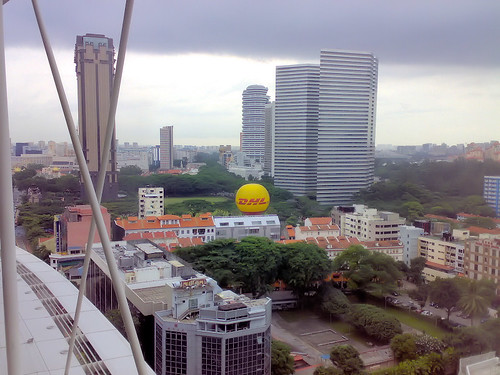
7th Storey Hotel
View of 7th Storey Hotel from National Library Building. Can you find the hotel?

Shaw Towers was built 20 years after the hotel. Many buildings could have been built in this time gap, and usurped the hotel.

One such building hides behind the shadow. I missed it during my initial coverage of the hotel.
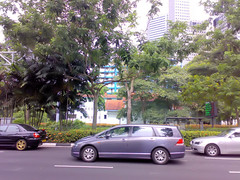
Beach Road Police Station
A candidate hiding behind the shadow.

The shot was taken when I went to the hotel again. If you read my blog, I did go back to check out the lift numbering.

So how did I "discover" the building? I didn't, actually. By a stroke of luck, I found the following picture on our National Archives website while idly surfing for non 7th Storey Hotel material.

The picture shows not the building, but 7th Storey Hotel!
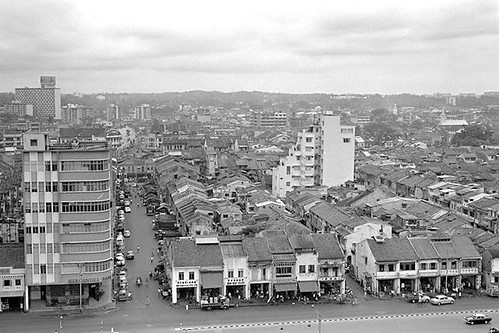
Tan Quee Lan Street
Source: National Archives of Singapore

The picture couldn't have arrived at a better time. I blogged about Farquhar Street few entries back and wondered how it looked like. Now I have my answer.

The archive states the record date as 1970. Assuming this is correct, the picture was taken in the late 60s or 1970.

By this time, the hotel has a contender at the Tan Quee Lan Street-Beach Road junction. Look at the left foreground. I think it is called Premier Center today. Count the storeys carefully. It is still not tall enough to usurp the hotel.

A little diversion into the history of the contender leads to something interesting. Look at the picture from the Chinese newspaper at the beginning of this entry again. It is not clear, but will still do. Pay attention to a landmark at the bottom right of the picture.

The landmark should be Sultan Mosque. With the hotel at 10'o clock position, the orientation of the picture is such that the sea will be outside to the left of the picture.

An interesting question arises - where is our contender? Today the two buildings are at stone throwing distance from one another. In the 1950s picture, surrounded by a field of shophouses, the hotel does look like a "crane among the chicken crowd" (鹤立鸡群). The contender is nowhere to be found.

Or is it?

Look at this aerial view from the 1950s, oriented as a top-down view of the Archives picture. The contender stands out, almost like a twin to 7th Storey Hotel!
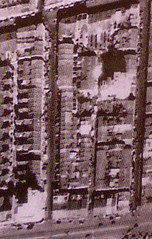
26072008420
7th Storey Hotel with the vertical running Tan Quee Lan Street and Rochor Road. North Bridge Road is on top and Beach Road at the bottom.

Both mirrored-L buildings stand out prominently in this aerial view. You can see both are tall buildings by the shadow they cast on their neighbors.

Thus the picture from the Chinese newspaper is misleading. Before 1960, there were actually two cranes in close proximity on the southern skyline. I've not seen before the source picture used by the Chinese newspaper. Perhaps the other crane is really missing in the source, which led to the use of the Chinese idiom. Or perhaps, the other crane was deliberately left out to justify the idiom.

Of course there is the possibility that the other crane was only a small crane and relegated to the chicken brood. In my blog comments, Victor replied that in countries like China, owners can easily add more floors to a completed building. Maybe like the citadels of Europe, the building took decades to reach its current height.

But looking at the shadow created by the twin crane in the aerial view, this is not likely. The building looks tall from its shadow.

With a 100m advantage to Beach Road, the building should offer a pretty good view of the beach if you are on the top floors. But 7th Storey Hotel, while 100m back, is taller and has a roof view. This was highlighted by the hotel's operations manager Ms Fong, "If you got the roof, it had the best views of the beach" (see beginning of this entry). Notwithstanding that by the 1950s, the coastline has shifted from the original 1843 coastline beside Beach Road to beyond Nicoll Highway. The highway was completed in mid 1950s.


The above picture comes from the same Chinese newspaper. Beach Road (美芝路) and Nicoll Highway (尼浩大道) are labelled. The hotel is circled.

Back from the little diversion into the pseudo-contender. The contribution of the 1970 Archives picture is to lead us to the real contender. Somewhere on this contender, the Archives picture was taken.

So how does our contender look like?

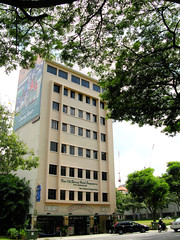
At the Tan Quee Lan Street side of Beach Road, the building is partly blocked by trees, as shown in the "teaser" picture further up. I have to cross the road to get a clearer view.
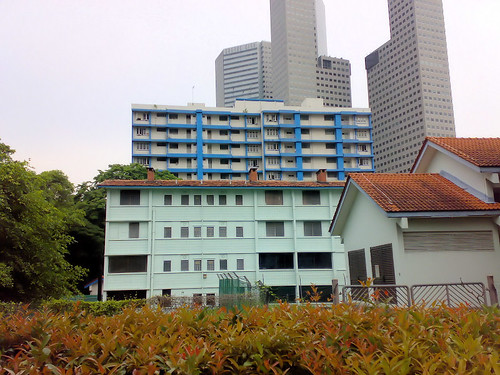
Beach Road Police Station
Former Beach Road Police Station

This looks like some hostel building inside the former Beach Road Police Station. I'm not sure when it was built, but clearly it has usurped 7th Storey Hotel.

An usurper before Shaw Towers has been found. But is this the earliest usurper? When was 7th Storey Hotel usurped and by who?

I end this topic with another picture of the usurper. The picture is courtesy of my friend Christine, who works in that de-facto crane building. I've asked her to take some shots of the scenery from her tall vantage point. Thanks Christine!
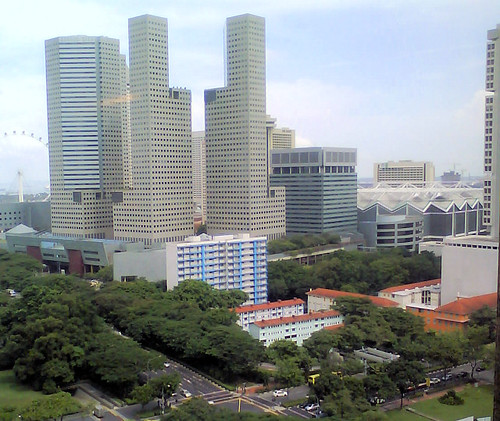
Beach Road Police Station by Christine
Today, the building in the former Beach Road Police Station is dwarfed by her neighbors.

Jul 15, 2008

Why 7th Storey Hotel is still 7th Storey?

The New 7th Storey Hotel went under the limelight recently because of LTA's decision to demolish it to make way for the new Downtown Line Bugis Station.

This grand dame from the 1950s is going, and I decided that I have to blog about it.

Huh, but the nonsensical title?

You see, if you first come across the name, you'd think the hotel has only seven storeys. Ok, maybe not so because of the difference between ordinal and cardinal numbering. It is seventh storey, not seven storeys. But the human mind often works by association, so putting a number and a noun together will give the impression of having x-number of that noun.

Luckily the Chinese name is not that confusing. "七层楼酒店" means seven storeys hotel. So 7th Storey Hotel should be a seven storeys hotel.

Until you read what the articles say.

Take the June 27 ST when the groundbreaking news was announced, "55-year-old hotel to make way for MRT":
The hotel, which actually has nine storeys despite its name, was opened in 1953 by the late property magnate Wee Thiam Siew.
So it is actually a nine storeys hotel.

Since only seeing is believing, I went down for a look.

7th Storey Hotel
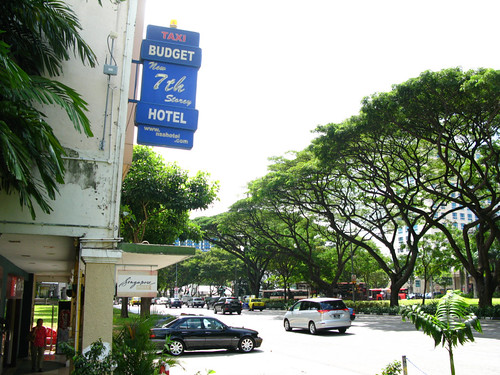
Picture from opposite side of Rochor Road. For half a century, cars and pedestrians have drove or walked past the hotel. How many have counted whether the storeys match up to the name?

From the front side, you count only eight storeys. You can include the rooftop but this is definitely not the convention.

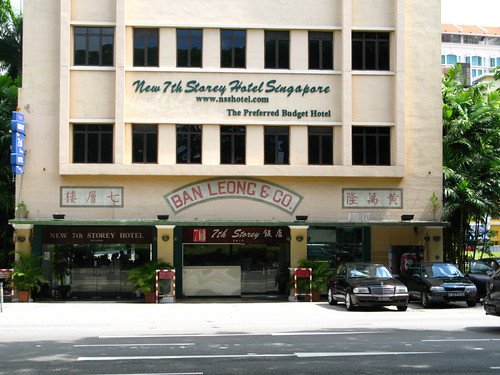
7th Storey Hotel
Close-up of the entrance

The above shot is interesting for two reasons.

First, the discrepancy between the English and Chinese names. The name change to New 7th Storey Hotel is not consistently reflected in the Chinese version, i.e. 新七层楼酒店. According to this article, the name change was to rebrand itself targeting backpackers and avoiding competition with international branded hotels. I'm guessing the name change is more of marketing tactic than change in identity. In that case, will the hotel be called New New 7th Storey Hotel in future?

Second, a cursory glance at the ground floor does not tell you that the building is a hotel. For example, it is more logical to think that the building is owned by Ban Leong and has seven storeys. The sign arc is so prominent! According to Peter Chan (quoted by Victor in his blog comments), Ban Leong had a tyre shop at the hotel in the 1960s, which explains the sign. Under the Ban Leong sign, at the center, you'd expect to find the entrance to the building, which happens to be a restaurant in this case (7th Storey 饭店).

I'm not sure how this Ban Leong is related to the Ban Leong known by most people, especially IT geeks. To contact this Ban Leong, you can use the Internet Yellow Pages. Search under Name/Phone for "Ban Leong (1961) Pte Ltd". Guess where is their office?

The Internet Yellow Pages classifies them as a tobacco dealer. Right, they distributed the 555 Brand cigarettes, according to this article. But do they still do tyre business? The closest Ban Leong doing tyre business is this Syarikat Ban Leong in Malaysia. Again, are they related?

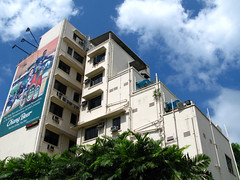
Back to exploring the hotel. To find the last storey, you have to do like what Victor wrote in his blog - go to the backside.

7th Storey Hotel
The hotel from the back

Indeed, what appears as the rooftop from the front side is not the rooftop yet. The hotel looks different from the front and back. The architectural gems, like the terrace design and "hidden" top level, are not visible from the front face.

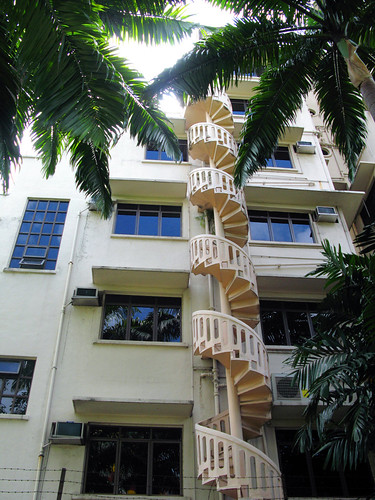
From the side, you find one of the hotel's treasure, its spiral staircase.

7th Storey Hotel
The hotel's quaint spiral staircase

The hotel is not very big. Take a few steps from the spiral staircase and you're back at the front.

7th Storey Hotel
The hotel is next to the road. There is no multi-storey carpark.

This ends my rather short coverage of the hotel. If you want to see photos of the interior, try the blog by Ah Leng or simply the photo gallery on their official website.

As to how the hotel got its name and why the name is still valid despite having nine storeys, I offer you three perspectives.

From me:

My initial hypothesis was that the hotel has seven storeys and its name and reality do match. The trick is in the definition. According to wikipedia:

In British English, in reference to typical buildings, the "first floor" is the first floor above the ground; but in American English, it is another name for the ground floor.

Most European countries, Latin American countries, countries of the Commonwealth (except Singapore and parts of Canada, which use the American system), and former British colonies like Hong Kong, follow the same convention as the British. Finland, Norway, Russia, some countries of East Europe, and most of eastern Asia (including China and Japan) have a convention similar to the American system.

Thus, from the front face at least, the hotel has seven storeys (according to British system). The top storey is more of a rooftop space. I'm thinking it is out of bounds to guests. From a 2002 ST article:

In case you ever wondered: the 7th Storey Hotel at 229 Rochor Road doesn't have only seven floors. There are nine levels, including a rooftop space and a tiny shed to house its lift engine..

Though Singapore now follows the American system, it is possible that in the early days, the British system was followed. There was heavy British usage of the hotel - in the 50s and 60s British officers used the top floor for cha cha parties.

How can we test the hypothesis? The most direct way is to check the hotel's lift numbering. In my mind, there are two possible patterns:

G, 1, 2, 3, 4, 5, 6, 7, (x)
1, 2, 3, 4, 5, 6, 7, 8, (9)

The first is how the British system could be represented. The second is the familiar Singapore system. Since I'm not sure whether the top storey is accessible by the lift, I put them in brackets.

To verify my guess, I made a second trip to the hotel. This time to the interior.

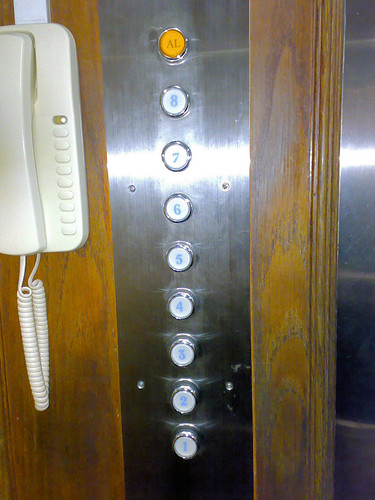
The hotel is famous for its fully manual "cage" lift. You can read and see photos of it elsewhere. I just show you the lift numbering here. In fact, this is the only photo I've taken of the hotel interior. The staff must be thinking I'm weird.

7th Storey Hotel
Storey numbering inside the cage lift

Oh no! Singapore system ....

The 'AL' button got me stuck for some time, until I realize it is the alarm button. Should be lah.

From public domain:

The ST article "Hard to say goodbye" on July 6 told us:

Contrary to its name, the New 7th Storey Hotel has nine storeys. Its operations manager, Ms Shirley Fong, 32, explains that the owner had decided on the name when architectural plans showed that it could be built up to nine storeys.

'The postal code for the hotel then was also just 7,' says Ms Fong, who has been with the hotel for eight years.

The article is unclear on the origin of the name. If the limit is nine storeys, why didn't the owner, presumably Wee Thiam Siew, choose 8th Storey Hotel?

That the postal code was also a 7 is more like a coincidence and auxiliary reason.

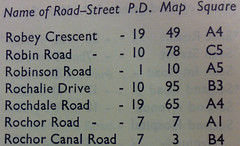
Anyway, let's verify whether it was a 7 last time. A shot of an early 1960s street directory:

Rochor Road Postal District
Postal district of Rochor Road

The current address of the hotel is 229 Rochor Road, Singapore 188452. The hotel has always faced Rochor Road, so it had a postal code of 7 last time, 7 being the postal district of Rochor Road.

Nowadays we use the six digits postal code but postal districts are still used by, not postmen but property agents. District 9 and 10, sounds familiar? Here is a website mapping the old postal districts (28 of them) to the new six digits code. The new code has the format ABXXXX. AB represents the postal sector (81 of them). For the hotel, 18 is the postal sector.

Thus, we see there's nothing amazing about having 7 as the postal code last time. Everybody along Rochor Road and Rochor Canal Road has the same postal code as you.

From staff:

You could have guessed why I leave this last. Like they say, save the best for the last.

On the day I went into the hotel to take that only shot of the lift interior, I met this cleaning auntie at the ground floor. I call her auntie out of respect, to differentiate her from other young female staff.

If you remember what happened, I went into the hotel to verify my hypothesis. I was expecting the cage lift to use the British system. If so, I considered my mystery solved and case closed.

But I was disappointed. The quaint cage lift does not use the British system. Nevertheless I took a picture of the lift buttons. It shall be evidence of my failed hypothesis.

I did not give up, however. I pretended to look at the framed newspaper articles on the wall beside the entrance. I wasn't really interested in them as I've read them online. All the while, the auntie was doing her cleaning beside me. As she was friendly to me and even helped arrange my photo taking inside the lift (note I wasn't a hotel guest and they disallow non-guests to use the lift for personal reasons), I felt she could help me. So I bidded my time.

I finally mustered the courage to ask her the question. I asked whether the hotel was like that since the beginning and why it is called 7th Storey Hotel. Why the discrepancy?

Without pause, she replied confidently, "因为八楼是 office".

(Translated, it means 'because the 8th storey is the office')

--------------------------------------------------------------

Guys, which perspective has your vote? :P